Service Area SEO vs Physical Location SEO: Understanding The Difference
When businesses start investing in local SEO, one question often creates confusion:
Should you optimize as a service area business or as a business with a physical location?
The distinction matters because Google treats these business models differently when determining local search visibility and Google Maps rankings.
Understanding how each model works can help businesses build stronger local SEO strategies and avoid common visibility issues.
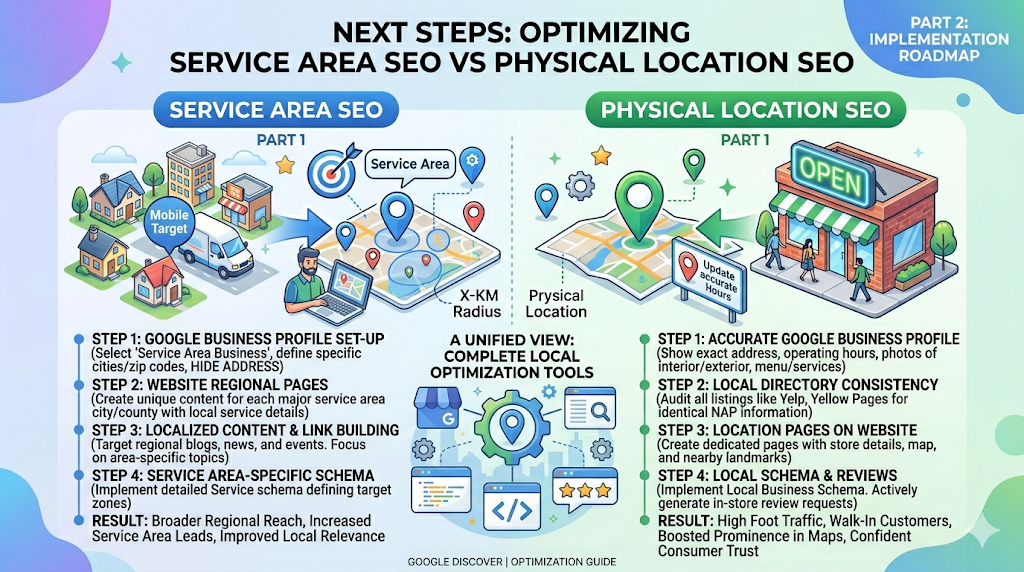
What Is A Physical Location Business?
A physical location business serves customers at its business address.
Examples include:
- Dental clinics
- Restaurants
- Gyms
- Retail stores
- Medical practices
- Salons
Customers visit the business location directly.
Because of this, Google can easily associate the business with a specific geographic location and display it in relevant local searches.
Businesses with physical locations often benefit from stronger proximity signals because users can visit the listed address.
What Is A Service Area Business?
A service area business travels to customers rather than serving them at a public business location.
Examples include:
- Plumbers
- Electricians
- HVAC companies
- Pest control providers
- Home cleaning services
- Landscaping companies
These businesses typically hide their address in Google Business Profile and define service areas instead.
Google then uses various relevance and authority signals to determine where the business should appear.
Why The Difference Matters For Local SEO
Many businesses mistakenly apply the same SEO strategy to both models.
While there are similarities, Google evaluates service area businesses and physical location businesses differently.
Factors such as proximity, service area relevance, content strategy, and local authority can influence rankings in different ways.
A strategy that works well for a dental clinic may not work equally well for a plumbing company operating across multiple cities.
Local Rankings For Physical Location Businesses
Physical location businesses generally benefit from having a verified address.
Google can clearly identify:
- where the business operates
- where customers visit
- proximity to searchers
For example, if someone searches for:
“Dentist near me”
Google often prioritizes businesses closest to the searcher’s location while also considering relevance and authority.
Because proximity plays a significant role, businesses with strong local relevance often gain an advantage.
Local Rankings For Service Area Businesses
Service area businesses face a different challenge.
Because customers are served at their location rather than at the business address, Google must rely more heavily on additional signals.
These may include:
- Service area settings
- Website content
- Reviews
- Local authority signals
- Citations
- Geographic relevance
Many service area businesses assume simply adding multiple cities inside their Google Business Profile will improve rankings.
Unfortunately, local visibility is rarely that simple.
Google still evaluates trust, relevance, and authority before determining visibility.
Common Mistakes Service Area Businesses Make
Many service businesses struggle because they:
- Target too many cities at once
- Create thin location pages
- Use duplicate content
- Ignore local authority building
- Focus only on Google Business Profile
As competition increases, these mistakes make it difficult to achieve sustainable visibility.
Common Mistakes Physical Location Businesses Make
Businesses with physical locations often assume their address alone is enough to rank.
However, many still struggle because they:
- Neglect Google Business Profile optimization
- Ignore reviews
- Use generic website content
- Fail to build authority
- Overlook technical SEO
A business address provides an advantage, but it does not guarantee rankings.
The Role Of Location Pages
Location pages can be powerful when implemented correctly.
A strong location page should provide:
- Useful local information
- Relevant services
- Unique content
- Trust signals
- Clear business details
Many businesses create dozens of nearly identical pages targeting different cities.
This often creates weak content that adds little value to users or search engines.
Quality consistently outperforms quantity.
Reviews Matter For Both Models
Regardless of business type, reviews remain one of the strongest trust signals.
Google uses reviews to better understand:
- customer satisfaction
- business credibility
- local relevance
Businesses that consistently earn authentic reviews often strengthen both visibility and conversion rates.
Authority Still Wins
Whether a business operates from a storefront or serves customers across multiple locations, authority remains a critical ranking factor.
Authority can come from:
- quality backlinks
- local mentions
- trusted citations
- strong content
- branded searches
- positive user engagement
Businesses that invest in authority-building often outperform competitors relying solely on proximity.
Which Model Is Better For Local SEO?
Neither model is inherently better.
Both can perform exceptionally well when supported by a strong local visibility strategy.
Physical location businesses may benefit from stronger proximity signals.
Service area businesses may benefit from broader geographic opportunities.
Success ultimately depends on how effectively a business builds relevance, trust, authority, and user value.
The Future Of Local Search
As AI-driven search and entity-based understanding continue to evolve, Google is becoming increasingly sophisticated at understanding businesses and their service areas.
Businesses that focus on building genuine authority, strong local relevance, and trustworthy customer experiences will likely remain more visible as search evolves.
The goal should not simply be ranking in one city but becoming the most trusted option within your market.
Final Thoughts
Understanding the difference between service area SEO and physical location SEO is essential for building an effective local search strategy.
Both models require thoughtful optimization, strong authority signals, and a commitment to long-term visibility.
Businesses that focus on relevance, trust, and customer experience are better positioned to generate sustainable local growth regardless of how they serve their customers.
Want Better Local Visibility?
RankScalers helps businesses improve Google Maps visibility, local authority, and organic discovery through strategic SEO systems designed for both service area and physical location businesses.
Request a Visibility Audit to uncover opportunities limiting your local search performance.